News from the Leading Advocate for Water Reuse
View in your browser
WateReuse Review banner

November 3, 2025

Symposium: Early Bird Registration Open Now

The Early Bird registration window for the 41st Annual WateReuse Symposium is open from October 28 through December 16! Join us at the InterContinental Los Angeles Downtown from March 8-11 for the most comprehensive conference for water recycling professionals. 

Our plenary panels this year will focus on timely water reuse issues: water reuse for data centers and the high-tech industry, water reuse in the American Midwest, and financing strategies for direct potable reuse projects. Hear from leaders and experts across municipalities and private industry on the partnerships that are driving successful water reuse projects. 

Register Here
Washington Update
WateReuse and Water Sector Groups Urge Administration to Release WIFIA Loans

Since its inception roughly ten years ago, the Water Infrastructure Finance and Innovation Act (WIFIA) loan program has provided several billion dollars in low-interest loan capital to dozens of water reuse projects across the country. However, since the beginning of President Trump’s second term, only one of roughly two dozen outstanding WIFIA loans has been closed. The other pending loans, which have gone through a rigorous application process and been vetted by the U.S. Environmental Protection Agency’s (EPA) Office of Water, await approval by the White House Office of Management and Budget (OMB) and EPA leadership. Last week, WateReuse helped organize and deliver a letter from water sector associations urging the Trump Administration to begin closing pending WIFIA loans, including those supporting water reuse projects.  

Read the Letter
State Updates and Member Profiles
Welcome New WateReuse Member!

The WateReuse Association welcomes Provo City, Utah! This year, Provo marked the opening of a new water recycling facility which uses membrane bioreactor technology to remove phosphorus and nitrogen, protecting Utah Lake from harmful algal blooms. The city also launched the final phase of its aquifer storage and recovery project this year, which diverts water from the Provo River into its aquifer. Provo City’s water utility serves over 115,000 residents. 

Provo City
CA: Pure Water San Diego Considers Direct Potable Reuse for Water Reuse Expansion 

Pure Water San Diego is a phased, multi-year program that could provide nearly half of the city’s water supply locally by the end of 2035. The first phase is under construction to supply purified water into the Miramar Reservoir, permitted under California’s long-standing regulations for indirect potable reuse. Last week, The San Diego Union-Tribune reported that the city is evaluating direct potable reuse under new California regulations for its second phase of the project. Direct potable reuse would allow the city to avoid building two new pipelines, saving billions of dollars and preventing hikes in water and sewer rates for customers. WateReuse member Stantec is currently performing consulting services for the city, evaluating different scenarios to make the project more cost-effective for the city and its residents. The city is currently exploring whether reduced demand due to successful conservation programs could justify a lower-capacity system than originally planned. “What we’re trying to do is make a very thoughtful decision that is best for the community, without building something that is too big,” said Juan Guerreiro, public utilities director at the City of San Diego.  

Read More
CA: Donald C. Tillman Facility Undergoing Upgrades to Double Recycled Water Capacity   

Last week, the board of Los Angeles Department of Water and Power voted to nearly double the amount of water recycled for potable reuse at its Donald C. Tillman Wastewater Treatment Plant in Van Nuys. The facility is currently undergoing expansion, expected to be completed by 2027, to bring its capacity to 45 million gallons per day. The City Council will vote on whether to approve the decision to utilize its full capacity. If approved, the facility is expected to begin operations at full capacity in 2028, supplying enough water for about half a million residents. The project is a part of the overall Pure Water Los Angeles effort to recycle all the city’s water by 2035. 

Read More
TX: Texas A&M Report Calls for $154 Billion Investment in New Water Supply Including Water Reuse and Aquifer Recharge 

This month, Governing highlighted research findings from the Texas Real Estate Research Center at Texas A&M University that indicate Texas must invest as much as $154 billion in water reuse, desalination, and aquifer recharge projects to accommodate a projected 50 million residents by 2027. The article notes that 4% of Texas’ water supply comes from reuse, referencing Big Spring – the nation’s first direct potable reuse project – Wichita Falls, and de facto indirect potable reuse via constructed wetlands in the Fort Worth region. However, Texas expects a decrease of 18% in total available water supply by 2060, and by 2070 may face a shortfall of 7-million-acre feet of water in severe drought conditions. Harold Hunt, a research economist with the Texas Real Estate Research Center, noted that public trust is a potential barrier to scaling up: “I think it takes education,” he said, “If you explain to people what’s going on and that it’s safe, it’s not a problem.” 

Read More
Midwest: Great Lakes Commission Resolves to Expand Water Reuse Efforts

Last week, the Great Lakes Commission passed a resolution affirming the importance of non-potable water reuse and resolving to develop recommendations for expanding reuse in the region. The Commission brings together eight U.S. states and two Canadian provinces to balance use, development, and conservation of Great Lakes water resources. WateReuse Association supported the development of the resolution and is named in the document as the Commission's partner in sharing information and expertise on water reuse.

Sponsor Spotlight
Sponsor Webinar: Protecting Community Drinking Water with UV AOP Technologies

Wednesday, November 12 | 12pm – 1pm EST 

This webinar introduces the UV Advanced Oxidation Process (UV AOP), a proven method for degrading contaminants like 1,4-dioxane using ultraviolet light and oxidants. With no waste streams, a compact footprint, and full-scale implementation, UV AOP offers practical, cost-effective solutions for emerging water treatment challenges. This webinar will cover UV AOP fundamentals, real-world case studies, and how the technology compares to other treatment methods—plus guidance on operations, site suitability, and support resources. 

Sponsored by Trojan Technologies. 

Register Now
Industrial Update
Bluefield Report Projects U.S. Water Reuse Infrastructure Spending to Total $47.1 Billion through 2035 

This month, Bluefield Research published a report analyzing capital expenditure for municipal water reuse infrastructure and treatment systems through 2035, projecting a total of $47.1 billion in reuse-related expenditures. The report notes an increasing shift towards potable reuse, changing geographic trends, and an increase in industrial demand. According to the report, advanced treatment technology and facilities encompass 42% of the total projected expenditure over the next decade, and potable reuse is expected to account for 37% of all growth in reuse capacity. While the West and Southwest will still account for the greatest share of reuse capacity, notable growth is occurring in the Midwest and East Coast. Finally, the report explores municipal-industry partnerships for industrial water reuse, noting data centers as a driver of demand for municipal water.  

Our plenary sessions at the Annual WateReuse Symposium, March 8-11 in Los Angeles, will bring municipal and business leaders together to address reuse for the high-tech industries, reuse in the Midwest, and financing for direct potable reuse projects. Register to hear from experts about these emerging trends. 

Read More
Member Resources and Benefits
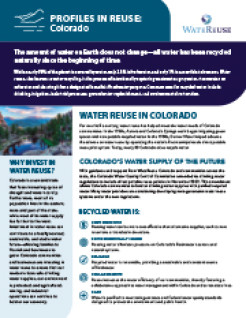
Profile in Reuse: Colorado 

For over half a century, water reuse has helped meet the water needs of Colorado communities. In the 1960s, Aurora and Colorado Springs each began irrigating green spaces with non-potable recycled water. In the 1980s, Denver Water helped advance the science on water reuse by operating the nation’s first municipal-scale direct potable reuse pilot system. Today, nearly 30 Colorado cities recycle water. Check out the WateReuse Colorado Profile in Reuse with simple facts, figures, and case studies about reuse in the state – and share it with everyone from policymakers to students. 

Read the Profile
WateReuse Events and Webcasts
Webcast – Water Recycling: Past, Present, and Future Through the Eyes of the Nation’s First Potable Reuse Project to Use Surface Water Augmentation

November 13, 2025 
10:00 am ET | 7:00 am PT 
Free to WateReuse Members 

Join us to learn about Upper Occoquan Service Authority's water recycling history & journey. Upper Occoquan Service Authority (UOSA) is a regional water recycling facility that protects public health and the environment as trusted stewards of our most precious resource – water. They have a long track record and will discuss their story along with how they are facing new challenges, such as emerging contaminants (PFAS), changes to influent load from water conservation, and changes to treatment targets. 

 
Presented by WateReuse Ohio. 

Register Here
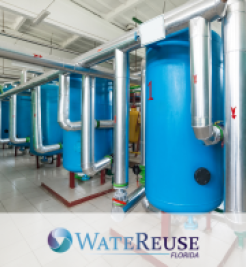
Florida Webinar – Implementation of Florida's Potable Reuse Rules: Case Studies in Permitting

November 13, 2025 
1:00 pm ET | 10:00 am PT
Free to WateReuse Members

In February of this year, Florida became the third state in the US to adopt statewide rules for both direct and indirect potable reuse. Join us for an in-depth discussion as we examine two case studies for potable reuse projects that have sought permits under the new rule. Representatives from Jacksonville Electric Authority and Palm Beach County will discuss the permitting process for the H2.O Water Purification Project and the Green Cay Phase II Project. Representatives from the Florida Department of Environmental Protection will also share strategies to alleviate permitting delays and impediments.  

1.5 PDHs will be available for engineers licensed within Florida. 

Presented by WateReuse Florida. 

Register Here
2026 WateReuse Symposium

March 8-11 | Los Angeles, CA

Super saver registration ends today for the premier conference on water recycling — attracting water professionals and water reuse practitioners globally for knowledge-sharing, networking, and collaboration. 

Register Now

Contact us at info@watereuse.org

Unsubscribe from WateReuse Review, Staff, Board of Directors -- Association

Opt out of all WateReuse email

610 Madison Street, Suite 101
Box 621
Alexandria, VA 22314
United States

 Facebook  X / Twitter  Web  Linkedin  Youtube